
Overview
High-Quality Instructional Materials (HQIM) are materials that are accessible, aligned to developmentally appropriate standards, and support students’ problem-solving skills, critical thinking, and language development. HQIM serve as a cornerstone for effective teaching and learning by ensuring that all students have access to coherent and challenging content. The use of HQIM is positively associated with improvements in student achievement, particularly in schools serving historically marginalized communities (Kane et al., 2016; Steiner, 2017). Moreover, when teachers use well-designed instructional materials, they can focus more on instructional strategies and formative assessment that improve student outcomes, rather than spending time developing content from scratch (Chingos & Whitehurst, 2012).
Independent curriculum review organizations such as EdReports have emerged as tools for evaluating HQIM, offering evidence-based reviews of materials in subjects like math, ELA, and science. EdReports is particularly credible as its review process is independent, uses rigorous methodology, and provides transparency to all stakeholders involved in the curriculum adoption process. To classify as high quality, instructional materials must meet several key criteria. These typically include: alignment with college- and career-ready standards (e.g., Common Core State Standards), support for diverse learners including multilingual and special education students, incorporation of culturally responsive pedagogy, and usability for both educators and students (EdReports, 2023).
The adoption and effective use of HQIM are deeply connected to systems-level coherence, which includes aligned professional development, instructional leadership, and collaborative planning structures (Kaufman et al., 2020, TNTP, 2018). In order for educators to meet the needs of all learners, there should be alignment between professional learning, curriculum, district/site instructional vision, and teacher practice. In the absence of systems-level coherence, even the best instructional resources can be challenging to adopt and implement with integrity.
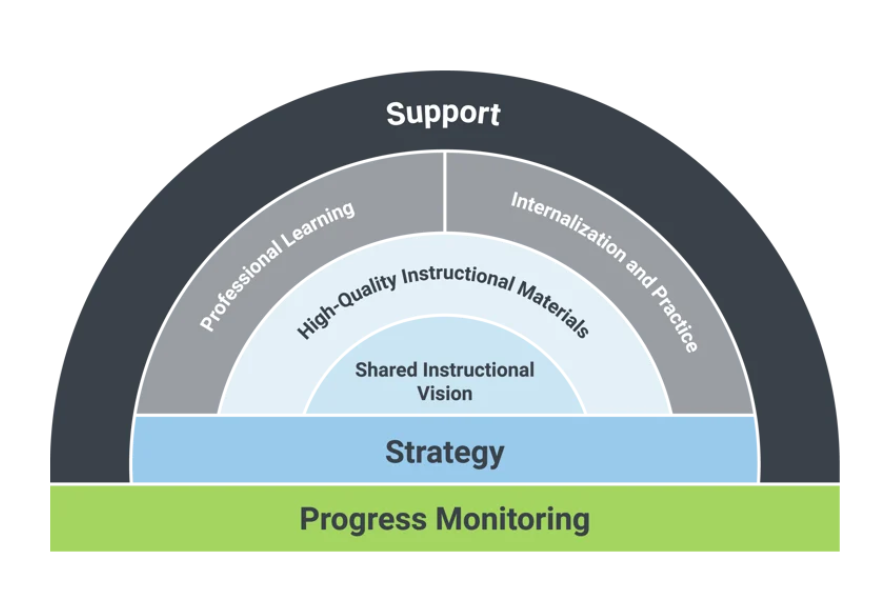
HQIM are a necessary foundation for strong instruction, but on their own they are not sufficient for changing teacher practice or leading to improved student outcomes. (EdElements)
Why Schools Need to Use High-Quality Instructional Materials
Instructional materials have a significant impact on student learning outcomes that can be comparable to or even greater than the effect of teacher effectiveness (Chingos & Whitehurst, 2012). The use of HQIM is essential for ensuring that all students receive equitable access to rigorous, standards-aligned, and inclusive educational experiences. Schools that fail to implement HQIM risk perpetuating achievement gaps, especially for students from historically marginalized communities by spending instructional time on learning experiences below grade level or misaligned to college and career readiness (TNTP, 2018).
Despite the importance of curriculum quality, many schools continue to rely on instructional resources that are misaligned with academic standards. According to a nationally representative study by the RAND Corporation (2020), only 15% of math teachers and 19% of ELA teachers reported using materials that were both aligned to standards and rated as high quality by independent reviewers (Kaufman et al., 2020). Similarly, EdReports found that fewer than half of the core ELA and mathematics programs reviewed met expectations for alignment to college- and career-ready standards (EdReports, 2022).
Equally concerning is the lack of accessibility and inclusive design in many current instructional materials. Research from CAST (2018), the developers of Universal Design for Learning (UDL), reveals that most materials in circulation do not address learner variability or provide multiple means of engagement, representation, and expression, the cornerstones of inclusive instruction. In the absence of such design considerations, students with disabilities, Multilingual Learners, and others who need differentiated support are less likely to access developmentally appropriate content. A study by the National Center on Accessible Educational Materials (2021) found that only 32% of educators reported that their core curriculum materials were fully accessible to students with disabilities.
When schools lack HQIM, teachers are often forced to create or curate their own materials, often from unvetted or low-quality online sources. For example, 96% of secondary ELA teachers and 99% of math teachers regularly use Google or Pinterest to find instructional content (Doan et al., 2021), and teachers spend 7-12 hours per week searching for and creating instructional resources, many of them unvetted (TNTP, 2018). This practice increases variability in instructional quality and undermines coherence across classrooms and grade levels.
Schools need HQIM not only to meet academic standards but also to fulfill the moral and legal imperative of providing an equitable education for all learners. Developing materials to meet the threshold for HQIM ensures that materials produced are aligned, accessible, and inclusive, supporting both teacher effectiveness and student achievement.
Designing HQIM
Designing HQIM requires a strategic and equity-centered approach that aligns content to rigorous academic standards while supporting diverse learners. The design process involves both high-level planning ("broad strokes") and specific, research-informed design criteria.
Broad Design Principles: Strategic and Learner-Centered
Education Elements (2020) identifies five foundational principles for HQIM design: ease of implementation, standards alignment, equity and inclusion, cognitive rigor, and adaptability for diverse learners. These principles ensure that instructional materials are not only academically rigorous but also usable by educators in real-world settings. Using these principles, designing HQIM begins with a backward-planning model: defining desired learning outcomes, identifying assessment methods, and then selecting or designing content that leads students toward mastery.
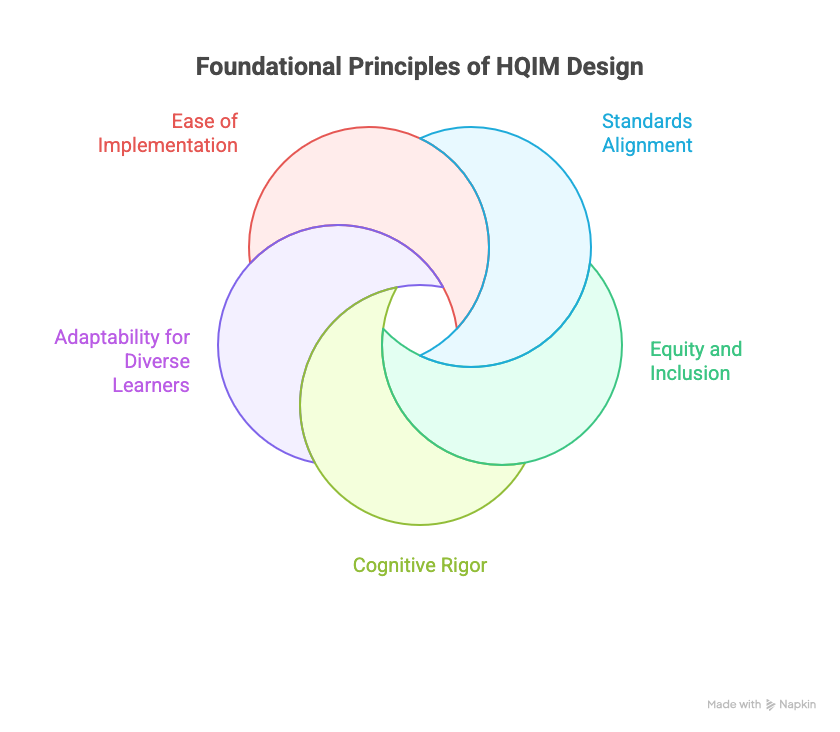
It is important to note that the principles are necessary but not sufficient to meet the needs of any particular context. Additional domains should be considered based on local context and needs. For example, districts may prioritize specific cultural representations, values, or place-based curriculum. It is also important that HQIM are flexible enough that teachers’ knowledge of students can be incorporated in the implementation of learning experiences, to personalize learning and meet the many needs of children that cannot be anticipated by the curriculum.

EdReports math curriculum evaluation tool includes indicators for supporting multilingual learners and drawing on students’ funds of knowledge.
A critical component of designing HQIM is the intentional scaffolding and differentiation to support all learners, including Multilingual Learners and students with disabilities. Materials should also reflect culturally responsive pedagogy, ensuring that students see themselves reflected in texts, examples, and tasks. The design process must also account for professional learning and planning tools for teachers to ensure effective implementation.
Granular Design Considerations: Alignment and Usability
While broad design principles provide a vision, tools such as EdReports offer granular evaluation criteria that can be used to design or assess HQIM during development. EdReports (2023) focuses on three key gateways:
Gateway 1: Standards alignment
Gateway 2: Instructional supports and usability
Gateway 3: Equity and access for all learners
To meet expectations in these areas, materials should demonstrate:
Explicit alignment to grade-level standards
Intentional learning progressions that build conceptual understanding over time.
Integrated supports for diverse learners, including: language supports, multiple representations, and scaffolds for students with disabilities.
Cohesive assessments that align with instructional goals and promote formative feedback.
Differentiating Design for Core, Supplemental, and EdTech Materials
It should be noted that the EdReports criteria are specific to core curriculum (e.g., full textbooks, digital curriculum that spans an entire school year). The design approach taken likely differs depending on whether the materials are core, supplemental, or technology-based tools. Core materials serve as the foundation of daily instruction and exhibit comprehensive coverage of standards, a coherent scope and sequence, and embedded formative and summative assessments. These materials demand rigorous attention to vertical and horizontal alignment and support whole-class instruction, and a guide for differentiating for small group and individual needs.
Supplemental materials are different in that they can be designed to target specific standards or learner needs. Their design may be more narrow in scope, but should be flexible and easily integrated with core curricula. Supplemental materials have an intended purpose and are designed to complement, not replace, core materials.
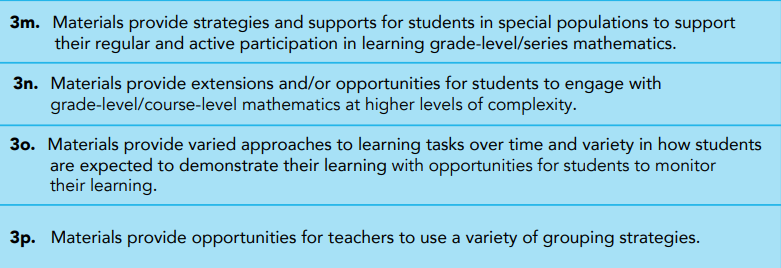
Though EdReports review tools are designed for core curricula, many of the indicators are appropriate to incorporate in the design of supplemental curriculum.
Educational technology products, such as adaptive learning platforms or digital assessments, add further complexity. While not always formally considered HQIM, many states and districts purchase and use them to supplement or enhance their HQIM. Their design often includes:
Interoperability with learning management systems (LMS) and other tools.
Accessibility features such as screen reader compatibility, alternative text, and closed captions.
Data transparency and instructional utility, i.e., how well the platform provides usable feedback to teachers and students.
Regardless of format, all HQIM should promote student agency, engagement, and equity through meaningful, standards-based instruction.
Additional Tools for Designing HQIM
There are several tools, frameworks, and organizations that contribute to an evolving ecosystem for evaluating HQIM. These resources help states, districts, and schools ensure that the materials they adopt are aligned to academic standards, accessible, and responsive to the needs of diverse learners. For curriculum developers, such review tools are helpful to inform the design of new curricula.
The Responsibility to Design HQIM
High-Quality Instructional Materials are foundational to advancing educational equity, improving student outcomes, and supporting effective teaching and learning. The creation and use of HQIM require not only a deep understanding of academic standards, accessibility, and instructional design but also a shared commitment across educators, developers, and publishers to go beyond superficial content delivery toward coherent, inclusive, and rigorous instructional experiences. Yet, the ability to meet this standard varies widely across stakeholder groups; teachers are often constrained by time and training, while publishers and curriculum developers hold greater responsibility and resources but require comprehensive frameworks and continuous feedback to ensure quality.
In the current educational landscape, the responsibility to design and disseminate HQIM extends across a range of actors: classroom teachers, curriculum developers, publishers, and edtech companies. Regardless of role or setting, those involved in creating instructional content bear a professional and ethical responsibility to ensure that materials support rigorous, equitable, and inclusive learning. Simply assembling content in the form of worksheets or disconnected tasks falls short of the pedagogical coherence and intellectual rigor that HQIM requires.
To meet the evolving and differentiated needs of those involved in HQIM development, HQIM Academy provides a comprehensive and targeted support system. Through its suite of online courses, personalized consulting, and downloadable tools and resources, HQIM Academy creates flexible learning pathways that are tailored to the specific roles and responsibilities of teachers, curriculum developers, and publishers.
We encourage curriculum leaders and district administrators to explore our curriculum development courses and services to see how we can best support you and your needs. You can learn more here or email: [email protected] for more information.
References
Achieve. (2019). EQuIP rubrics and feedback tools. https://www.achieve.org/equip
AEM Center. (2021). AEM needs assessment report: Perspectives from K–12 educators on the accessibility of instructional materials. National Center on Accessible Educational Materials. https://aem.cast.org
CAST. (2018). Universal Design for Learning guidelines version 2.2. http://udlguidelines.cast.org/
Chingos, M. M., & Whitehurst, G. J. (2012). Choosing blindly: Instructional materials, teacher effectiveness, and the Common Core. Brookings Institution. https://www.brookings.edu/research/choosing-blindly-instructional-materials-teacher-effectiveness-and-the-common-core/
Doan, S., Kaufman, J. H., Thompson, L. E., & Diliberti, M. (2021). How teachers use curriculum materials to support their instructional practice: Lessons from the American Instructional Resources Survey. RAND Corporation. https://www.rand.org/pubs/research_reports/RRA134-6.html
Education Elements. (2020). Designing for equity: Leveraging HQIM to advance teaching and learning. https://www.edelements.com/blog/designing-for-equity-leveraging-high-quality-instructional-materials
EdReports. (2022). 2022 annual report: Progress in the pursuit of high-quality instructional materials. https://www.edreports.org/resources/article/2022-annual-report
EdReports. (2023). What makes instructional materials high quality? https://www.edreports.org/resources/what-makes-instructional-materials-high-quality
HQIM Academy. (n.d.). Professional learning and resources to support high-quality instructional materials. https://learn.hqim.academy/
Kane, T. J., Owens, A. M., Marinell, W. H., Thal, D. R., & Staiger, D. O. (2016). Teaching higher: Educators’ perspectives on Common Core implementation. Center for Education Policy Research, Harvard University.
Kaufman, J. H., Opfer, V. D., Thompson, L. E., & Pane, J. F. (2020). Connecting what teachers know about high-quality instructional materials to their instruction. RAND Corporation. https://www.rand.org/pubs/research_reports/RR2484z2.html
Louisiana Department of Education. (2022). Instructional materials reviews. https://www.louisianabelieves.com/academics/ONLINE-INSTRUCTIONAL-MATERIALS-REVIEWS
Massachusetts Department of Elementary and Secondary Education. (2023). CURATE: Curriculum Ratings by Teachers. https://www.doe.mass.edu/instruction/curriculum
Steiner, D. (2017). Curriculum research: What we know and where we need to go. Johns Hopkins Institute for Education Policy. https://edpolicy.education.jhu.edu/curriculum-research-what-we-know-and-where-we-need-to-go/
Student Achievement Partners. (2016). IMET: Instructional Materials Evaluation Tool. https://achievethecore.org/page/2858/instructional-materials-evaluation-tool-imet
TNTP. (2018). The opportunity myth: What students can show us about how school is letting them down—and how to fix it. https://tntp.org/publications/view/student-experiences/the-opportunity-myth
Wisconsin Department of Public Instruction. (2022). High-quality instructional materials selection and implementation guide. https://dpi.wi.gov